

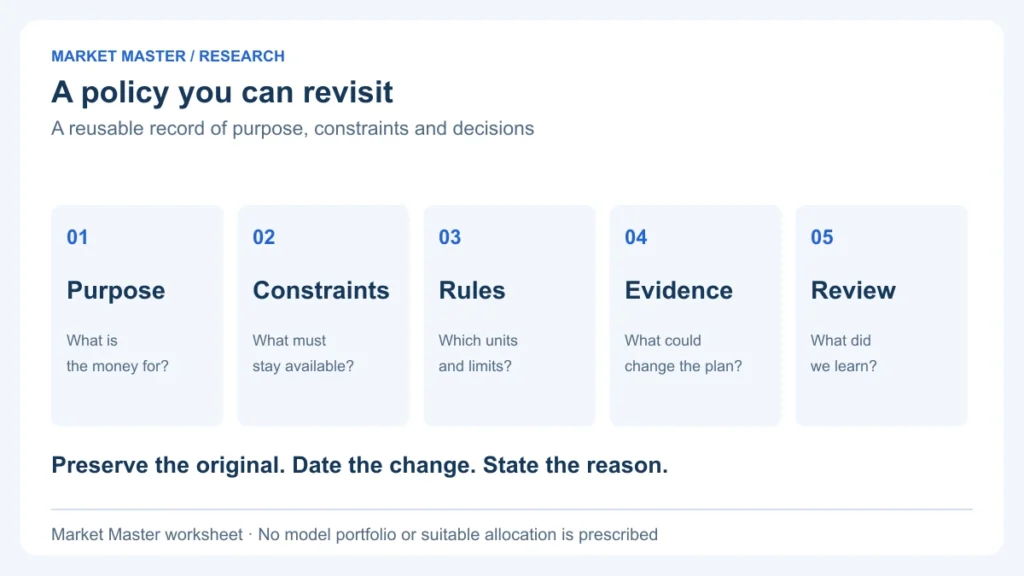
An investment policy statement is a record of how decisions should be made. Its value is not that it predicts the next market move. It makes the purpose, constraints and review conditions visible before a stressful headline encourages the investor to improvise. A useful one-page version is specific enough to expose a contradiction, while leaving room to revise the plan when the underlying circumstances genuinely change.
The worksheet below is a starting structure, not a recommended asset allocation or a substitute for advice about an individual’s circumstances. Account rules, taxes and available products differ by jurisdiction. Leave a field unresolved when the information is unknown; a blank that needs investigation is better than a number chosen simply to complete the page.
Download the one-page policy and review note →
An ungated plain-text template. Keep a private copy, edit it in your preferred application and do not send account credentials or personal financial records to the research assistant.
1. Write the purpose before choosing the product
Describe what the money is intended to do, when it might be needed and which currency the future spending uses. “Long term” is less informative than distinguishing a distant retirement goal from an expense expected within a few years. A single account can contain money serving different purposes, and combining them can conceal a conflict between the desired return and the need for dependable access.
A fictional note might say: “This portfolio serves a goal more than a decade away; near-term essential spending is handled separately.” That sentence does not establish that the arrangement is adequate. It identifies an assumption that can be checked rather than letting a chart determine the portfolio’s purpose.
2. State the constraints that a backtest cannot see
Record liquidity needs, contribution uncertainty, borrowing restrictions, account limitations and any concentration that already exists outside the portfolio. Employer shares, a family business or a property can make the person’s wider financial exposure different from the securities account alone. Record which facts have been checked and which require professional or administrative clarification.
Do not convert a willingness to tolerate a loss into proof of an ability to fund one. A hypothetical investor may say a decline is emotionally acceptable while also needing to withdraw money during that decline. Putting both statements on the same page makes the inconsistency available for review.
3. Define a review rule with units
If allocation drift triggers a review, specify whether the threshold means percentage points or a relative percentage. For a fictional 40% target, a five-percentage-point band runs from 35% to 45%. A five-percent relative band runs from 38% to 42%. These are different rules, and neither is a universal recommendation.
The rule should trigger an examination of costs, cash flows and circumstances, rather than an automatic instruction to trade. A contribution may reduce drift without selling. Tax treatment, execution costs and account restrictions can change the implementation. The allocation-drift example makes the unit distinction reproducible.
4. Decide what information can change the plan
Separate a changed personal constraint from a changed market opinion. A new withdrawal need, a change in employment or an account restriction may alter the original assumptions. A dramatic headline may instead create a research question without changing those assumptions. The policy can require a written explanation of which category applies.
Write the evidence needed before a revision is accepted. “Markets feel risky” is difficult to audit. “The original spending date moved forward; review the liquidity plan using the revised date” identifies both a changed input and the next task. The objective is better reasoning, not a rule that prevents any future change.
5. Preserve a short decision record
Before changing the policy, save the original version and record the date, trigger, evidence considered, alternatives and intended review date. After the review, distinguish the quality of the decision process from the outcome. A favourable price move does not prove that the original reasoning was sound; an unfavourable outcome does not, on its own, prove the process was careless.
Keep the statement short by linking supporting calculations rather than copying them into the main page. The Decision Workspace can hold the research process, while the free dashboard keeps saved work and review dates together. These records help revisit an assumption; they do not establish that a strategy suits a particular person.
A final consistency check
Read the completed statement as if another person had to apply it. Could they identify the purpose, constraints, units and next review conditions without guessing? Could they explain why the latest change was made? If not, revise the ambiguous field. The useful output is a document that helps distinguish a deliberate revision from a reaction that was rationalized afterward.
References and method
Use the references to check the factual explanations. Calculations and interpretations are Market Master’s own unless attributed otherwise. The assumptions and limits are stated alongside the relevant example.
Supporting references (2)
Investor.gov asset allocation and diversification ↗www.investor.gov
Investor.gov assessing risk tolerance ↗www.investor.gov
Published by Market Master, an owner-operated publication led by Andrejus S. Editorial responsibility and production methods · Report a correction.