

On the weekend Silicon Valley Bank failed, people could still sell USD Coin on crypto exchanges. Getting dollars directly from its issuer was a different matter. Circle said $3.3 billion of the stablecoin’s reserves sat at Silicon Valley Bank, about 8% of the total at the time. Federal Reserve researchers later reported that USDC traded as low as $0.86 in the secondary market. The two numbers describe different things. The first measures exposure to one bank. The second is a price formed by buyers and sellers while access to dollars was uncertain. Circle statement · Federal Reserve study
What happened over the weekend
On Friday, March 10, regulators took control of Silicon Valley Bank. Circle disclosed later that day that it had been unable to move the reserve deposit before the bank went into receivership. Federal Reserve researchers observed that redemption requests had already accelerated after the bank closure. They found that direct redemptions largely stopped over the weekend, while trading on exchanges continued. Without a dependable route from USDC to dollars at par, fewer traders could buy discounted tokens and promptly redeem them. Federal Reserve study of the primary and secondary markets
On Sunday, March 12, the U.S. Treasury, Federal Reserve and FDIC announced that Silicon Valley Bank depositors would have access to their money starting Monday. Circle said its reserve deposit would be available when U.S. banks reopened. The Fed researchers found that USDC’s exchange price recovered sharply after the announcement and returned to its peg after Circle resumed processing redemptions on Monday. The intervention addressed the bank deposits in this event. An exchange buyer’s direct access to Circle still depended on the issuer’s eligibility and operational arrangements. Joint regulatory announcement · Circle statement
A price, a sell order and a redemption can give three answers
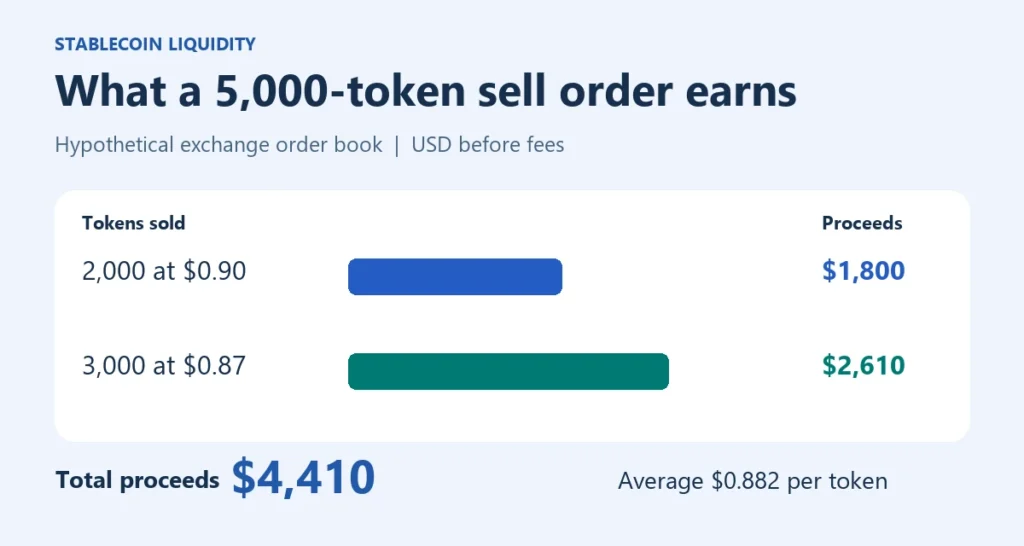
Suppose a holder has 5,000 units of a fictional dollar stablecoin. The reference value is $5,000. An exchange displays a best bid of $0.90, but only 2,000 units can sell there. In this hypothetical order book, the next 3,000 sell at $0.87. The figures illustrate order depth and are separate from the historical USDC observations.
| Route or assumption | Calculation | Dollars before fees |
|---|---|---|
| Value at the one-dollar reference | 5,000 × $1.00 | $5,000 |
| All units hypothetically fill at displayed best bid | 5,000 × $0.90 | $4,500 |
| Sell through the two available bid levels | 2,000 × $0.90 + 3,000 × $0.87 | $4,410 |
The two-level sale averages $0.882 per unit before fees, a shortfall of $590 relative to the reference. Multiplying all units by the best bid misses $90 of that shortfall. An eligible direct customer with an operating redemption route might face a different outcome and timing. A holder who needs usable dollars today should check available bids, platform fees, withdrawal access and settlement time together.
Follow the exposure into other tokens
The dependence extended beyond Circle. At the time Dai offered a smart-contract facility that exchanged Dai and USDC at one-to-one terms. Federal Reserve researchers found that this mechanism absorbed distressed USDC into Dai’s collateral pool and helped transmit pressure to Dai and other connected stablecoins. A reserve list can therefore understate how exposures change during a rush to exit. When assessing more than one token, map the banks, platforms and collateral they share, including the contracts through which balances can move in stress. Federal Reserve study of the Dai linkage
What to record during the next price gap
- Record a timestamped quote in a named market and the depth available for the size you are measuring.
- Find the issuer’s latest reserve disclosure and distinguish a temporary access problem from a confirmed loss of reserve assets.
- Check who can redeem, through which channel, when funds are available and what fees apply. Use the terms current at the time of the event.
- Keep the original observation and the later outcome separate. A recovery after public intervention tells you about that intervention and episode. Future prices and recoveries depend on their own facts.
Continue with the guide to stablecoin reserves, redemption and counterparties to apply the same checks to a different issuer or product.
References and method
Use the references to check the factual explanations. Calculations and interpretations are Market Master’s own unless attributed otherwise. The assumptions and limits are stated alongside the relevant example.
Supporting references (4)
Circle reserve update ↗www.circle.com
Joint U.S. Treasury, Federal Reserve and FDIC announcement ↗www.federalreserve.gov
Federal Reserve study of primary and secondary stablecoin markets ↗www.federalreserve.gov
Federal Reserve study of Silicon Valley Bank and stablecoins ↗www.federalreserve.gov
Published by Market Master, an owner-operated publication led by Andrejus S. Editorial responsibility and production methods · Report a correction.