

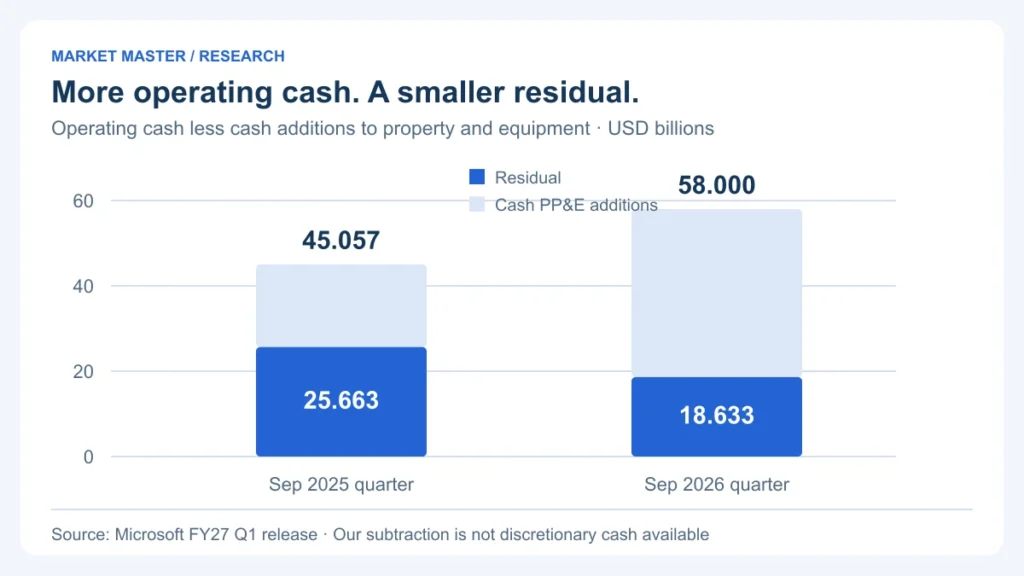
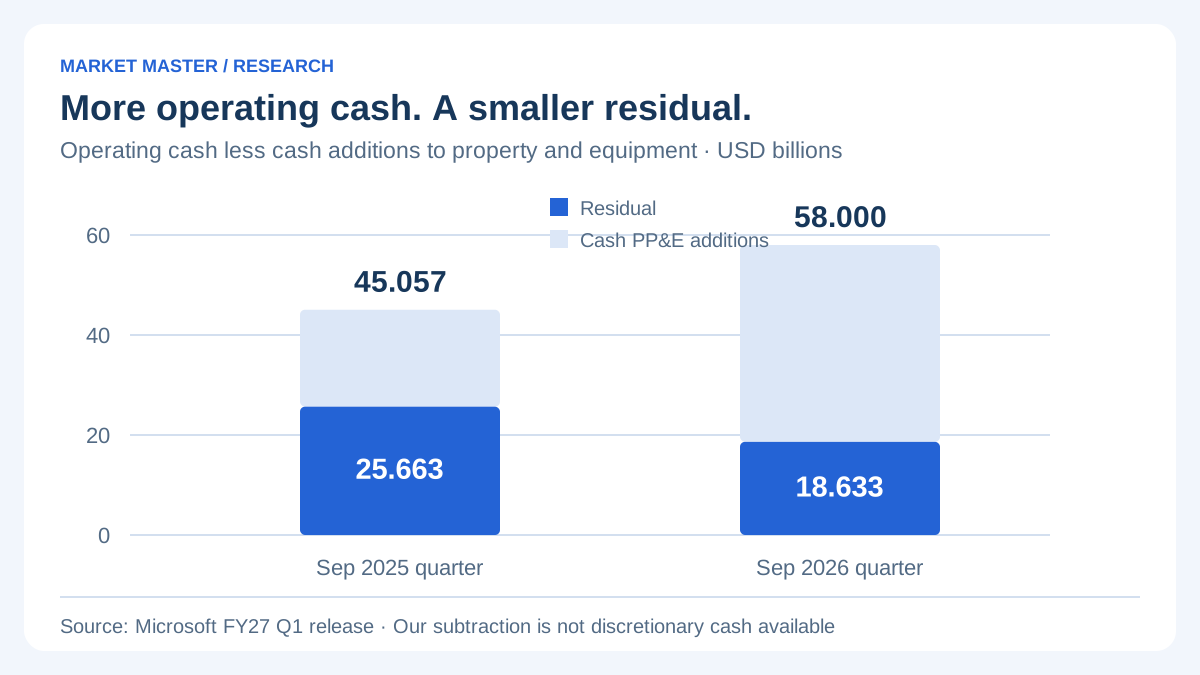
A company can generate more operating cash while retaining less after a major investment line. Microsoft’s first-quarter fiscal 2027 cash-flow statement provides a concrete example. For the three months ended September 30, 2026, reported operating cash flow was $58.000 billion, compared with $45.057 billion a year earlier. Cash additions to property and equipment were $39.367 billion, compared with $19.394 billion.
Subtracting that investment line from operating cash flow gives $18.633 billion for the latest quarter and $25.663 billion for the comparison quarter. The residual fell even though operating cash flow rose. This edition examines that reconciliation using the company’s October 28 earnings release. It is a reporting-period study, not a valuation conclusion or an explanation of a subsequent share-price move.
Reconcile the same lines in the same periods
| Item | 2025 quarter | 2026 quarter |
|---|---|---|
| Net cash from operations | 45.057 | 58.000 |
| Cash additions to property and equipment | 19.394 | 39.367 |
| Operating cash less that investment line | 25.663 | 18.633 |
| Residual / operating cash flow | 56.96% | 32.13% |
The source statement uses millions of dollars; the table divides those amounts by 1,000. Treat the negative investing cash-flow line as a positive cash outflow when performing the subtraction. The residual’s year-over-year change is 18.633 divided by 25.663, minus one, or approximately −27.39%. Operating cash flow grew approximately 28.73%, while the selected investment outflow grew approximately 102.99%.
Separate three research questions
The first question is cash generation: how much cash did operating activities produce during the period? The second is investment intensity: how much of that cash was absorbed by the specified property-and-equipment outflow? The third is future payoff: will the assets support attractive subsequent cash generation? The subtraction addresses the second question. It cannot answer the third without assumptions about future use, economics and continuing expenditure.
This prevents two opposite shortcuts. A higher operating-cash figure is not sufficient evidence that more cash remains after investment. A smaller residual is not sufficient evidence that the spending is wasteful. Each conclusion would require an additional argument. The useful observation is that investment absorbed a larger share of the quarter’s operating cash, changing the amount left after this particular deduction.
Why the residual is not a spending allowance
The SEC’s non-GAAP guidance explains why a free-cash-flow label needs a clear definition and reconciliation. Measures using that name are not uniform and should not imply that all residual cash is available for discretionary expenditure. A subtraction that omits debt service or other requirements cannot establish the cash safely available for distributions.
Our table therefore uses a descriptive label. It does not deduct every investing or financing cash flow, value future commitments, or convert finance-lease additions into current cash expenditure. The accounting statement’s cash additions line should not be casually substituted for every broader capital-investment measure discussed elsewhere in a release or earnings call.
Operating cash also deserves inspection
A cash-flow statement reconciles earnings with cash and includes working-capital movements. To investigate durability, trace the relevant receivables, liabilities and noncash adjustments across several periods. One quarter can be affected by collection timing and payment timing. Comparing equivalent quarters is a starting point, rather than proof that the current rate can be repeated indefinitely.
A practical note should distinguish a reported amount from the reason assigned to it. Write “operating cash flow increased” when the statement supports that observation. A claim that customer demand, payment terms or a particular product caused the improvement needs additional disclosure. Avoid filling gaps with a plausible industry narrative.
Carry the bridge into a valuation carefully
For a hypothetical business, test cash generation and reinvestment separately before estimating future cash flows. Holding one quarter’s residual constant forever hides assumptions about both. Conversely, projecting operating cash growth while silently freezing investment can manufacture an attractive result. The valuation lab can illustrate assumption sensitivity; it does not automatically import or verify this company’s forecast.
For the next reporting period, repeat the same line-by-line reconciliation, inspect any changes in definitions, and compare the wider cash requirements. Keep the original table available so a reader can see whether an apparent improvement comes from cash generation, lower investment, different timing or a changed method. That repeatable bridge is more informative than a stand-alone “strong cash flow” label.
References and method
Use the references to check the factual explanations. Calculations and interpretations are Market Master’s own unless attributed otherwise. The assumptions and limits are stated alongside the relevant example.
Supporting references (2)
Published by Market Master, an owner-operated publication led by Andrejus S. Editorial responsibility and production methods · Report a correction.