

A higher quoted yield does not mean that a bond fund has delivered a higher return to its existing holder. Yield describes an income or valuation relationship under a stated calculation. Return describes the investor’s change in value and income over an interval. The two can move in opposite directions because a lower price changes the relationship between the security’s price and its cash payments.
This guide uses fictional figures to separate those ideas. It concerns a conventional, unleveraged bond fund; an individual bond, a target-maturity fund, a money-market fund and a leveraged product can behave differently. Start with the actual product’s prospectus and the definition of the yield displayed by its provider.
A fund can pay income while its share price declines
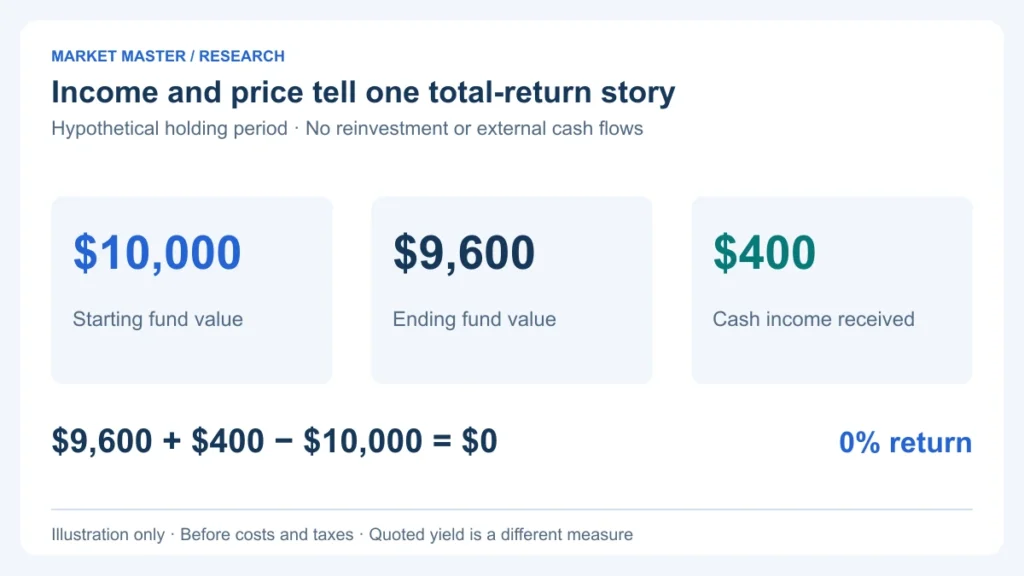
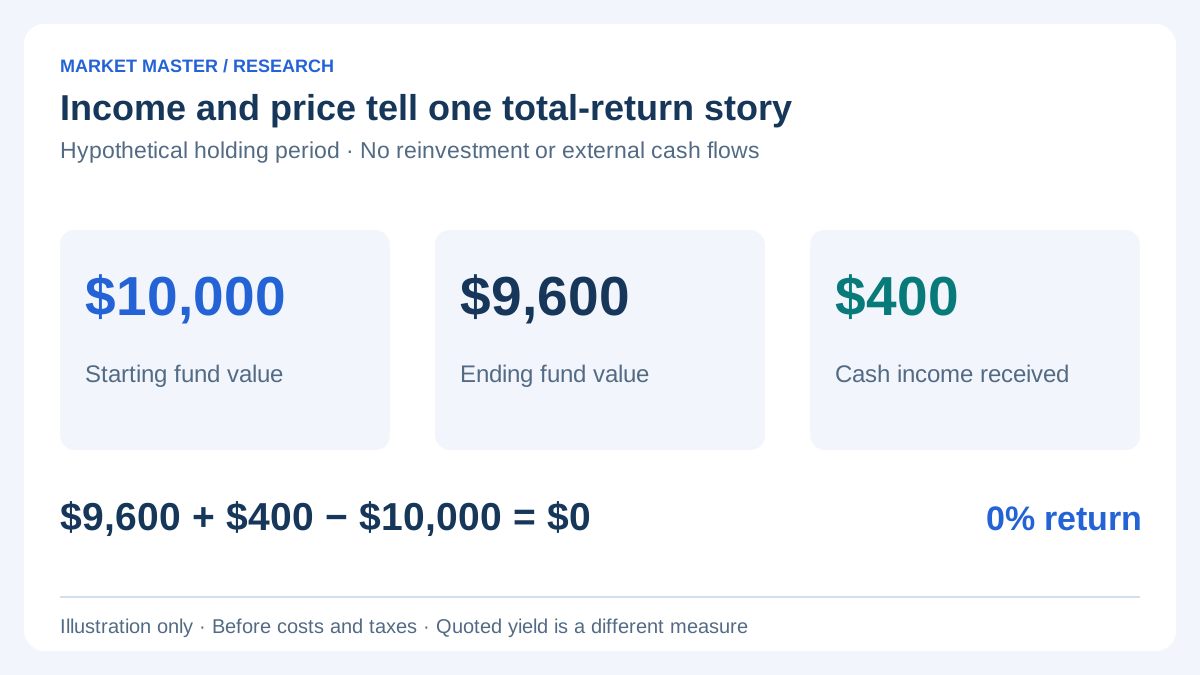
Suppose an investor buys 100 shares at $100 each, a $10,000 investment. During the chosen year, the fund pays $4 per share in cash distributions. At the end of the year, its share price is $96. The remaining fund position is worth $9,600, and the investor has received $400 in cash.
| Component | Amount |
|---|---|
| Starting fund value | $10,000 |
| Ending fund value | $9,600 |
| Cash income received | $400 |
| Ending value plus income, less starting value | $0 |
| Holding-period return | 0%, before costs and taxes |
The cash distribution is real income, but it does not sit on top of an unchanged $10,000 position in this example. Conversely, reporting only the $400 fall in fund value omits the cash received. With no external cash flows, the simplified holding-period return is ending value plus income received, minus starting value, divided by starting value.
Why the price and yield can move in opposite directions
The SEC’s interest-rate-risk explanation describes the underlying fixed-rate bond mechanism: existing bonds compete with newly available rates, so a rise in market rates can reduce the price investors will pay for existing fixed payments. A lower purchase price can increase the yield available to a new buyer while the previous holder experiences a price decline.
A fictional security paying $4 annually illustrates a narrow current-yield calculation: $4 divided by a $100 price is 4%; $4 divided by $96 is approximately 4.17%. That calculation is not a bond’s full yield to maturity and is not a standardized fund SEC yield. It ignores principal repayment, timing and other cash-flow details. Its purpose here is to show how a denominator change can raise a yield ratio while reducing the existing holding’s market value.
Read the yield label before comparing two funds
A distribution yield, a standardized SEC yield and a portfolio yield-to-maturity measure do not necessarily use the same numerator, period or assumptions. Check the provider’s definition, observation date, treatment of expenses and any unusual distributions. A recent payout annualized over twelve months is a different calculation from the return the investor will actually receive over the next year.
Ask whether the number is backward-looking, based on current portfolio income, or dependent on assumptions about future payments. Compare like with like. A yield ratio without its method is an incomplete basis for judging which of two funds offers more compensation for the risks it takes.
Use duration as sensitivity, not a promised loss
Duration provides a first-order way to describe sensitivity to a yield change. In a simplified example, a modified duration of five and a parallel one-percentage-point rise in yields imply an approximate 5% price decline: minus five multiplied by 0.01. A half-percentage-point move would imply approximately 2.5% under the same approximation.
This is not a complete fund forecast. Convexity, changes across different maturities, credit spreads, defaults, portfolio turnover and income affect the result. Duration is not the number of years until the fund must return the investor’s original capital. A conventional open-ended bond fund generally holds a changing portfolio rather than one bond that matures on a single promised repayment date.
A practical three-part check
- Record the price change and cash income for the same holding period, noting reinvestment and external contributions.
- Record the quoted yield’s exact definition and date; do not substitute it for realized total return.
- Inspect duration, credit exposure and the fund structure before interpreting a yield difference as an advantage.
The Treasury-yield guide explains the distinction between maturity points on the curve. The market terminal provides dated fund-price context where available. Fund prices alone do not supply the missing income, yield or portfolio-risk information.
References and method
Use the references to check the factual explanations. Calculations and interpretations are Market Master’s own unless attributed otherwise. The assumptions and limits are stated alongside the relevant example.
Supporting references (2)
SEC Investor Bulletin on fixed-income interest-rate risk ↗www.investor.gov
Investor.gov mutual funds overview ↗www.investor.gov
Published by Market Master, an owner-operated publication led by Andrejus S. Editorial responsibility and production methods · Report a correction.