

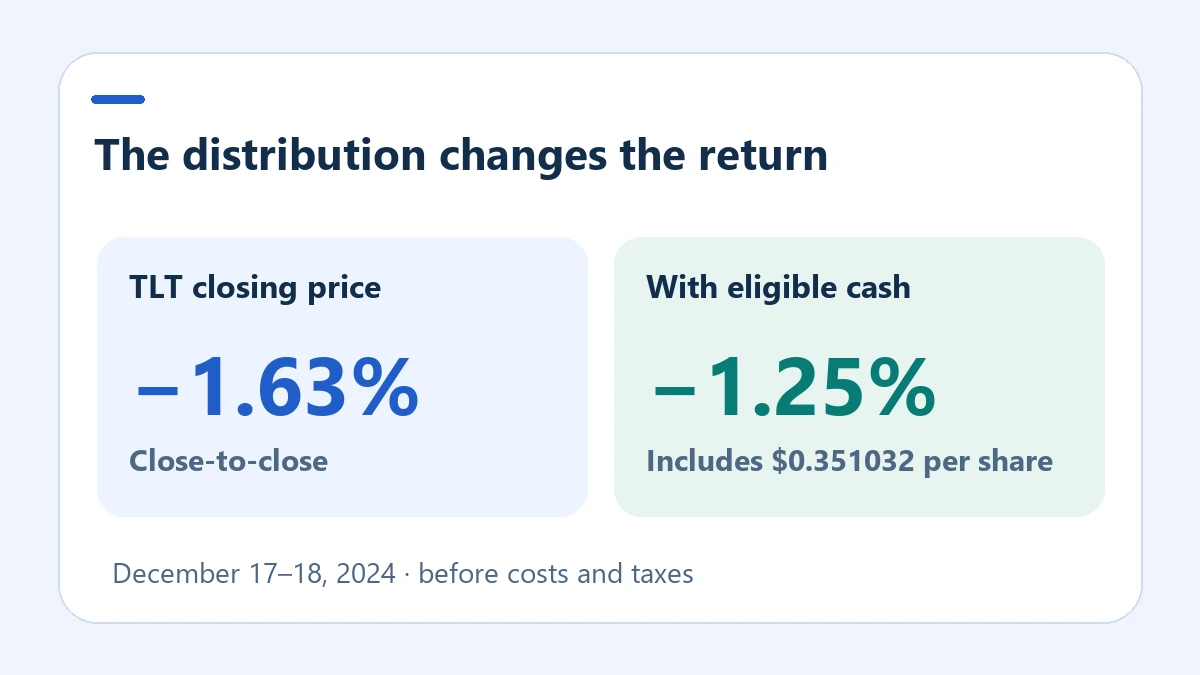
On December 18, 2024, the Federal Reserve lowered its target rate range by a quarter point. The Treasury’s 20- and 30-year par yields each rose six basis points from the previous session. TLT, an ETF that tracks U.S. Treasury bonds with remaining maturities over 20 years, closed lower. TLT also went ex-distribution that day. Accounting for the distribution makes the loss smaller and shows why a chart alone can misstate the experience of someone who held the fund. FOMC statement · iShares TLT fund profile
Compare the long end with the ETF close
| Session | 20-year Treasury par yield | 30-year Treasury par yield | TLT closing price | TLT cash distribution per share, ex-date |
|---|---|---|---|---|
| December 17 | 4.68% | 4.59% | $90.64 | , |
| December 18 | 4.74% | 4.65% | $89.16 | $0.351032 |
| December 19 | 4.82% | 4.74% | $87.81 | , |
Three contemporaneous pricing supplements filed with the SEC report TLT values that match the three closing prices in the table. BlackRock’s distribution record gives December 18 as the ex-date and December 23 as the pay date. Treasury fits its daily curve from indicative bids near 3:30 p.m. Eastern, and the fund close comes from a separate observation. Treasury daily par rates · December 17 SEC filing · December 18 SEC filing · December 19 SEC filing · BlackRock distribution summary
Calculate the move for a holder
Start with one share held from the December 17 close. The December 18 price fell by $1.48, or about 1.63%. An eligible holder also had a claim to $0.351032 per share, payable later. Add that cash entitlement to the December 18 close, divide by $90.64, then subtract one. The cash-inclusive change was about −1.25%. This calculation holds the cash outside the fund and excludes tax, reinvestment and trading costs.
| Window | Closing-price change | Change including eligible cash |
|---|---|---|
| December 17 to 18 | −1.63% | −1.25% |
| December 18 to 19 | −1.51% | −1.51% |
| December 17 to 19 | −3.12% | −2.73% |
For the overnight December 18 to 19 comparison, start with a new holder at the December 18 close. The distribution had already gone ex, so that holder has no claim to it. For the two-day window, add it exactly once. The distribution accounts for around 0.39 percentage points of the difference between the raw and cash-inclusive changes. If you instead start from an adjusted-close series that already includes distributions, adding the cash again double counts it.
Separate the policy decision from the price observation
The Fed changed an overnight policy target. The price of a fund holding long-dated bonds is sensitive to yields at longer maturities. This case shows those observations moving in opposite directions on the same date. It also shows why a fund’s price change needs to be interpreted alongside its cash flows.
The changes span complete sessions. The table cannot allocate the move between the statement, the projections, the press conference and other trading that day. The fund also holds a portfolio of individual securities, while Treasury publishes fitted par yields for standardized maturities. The same yield change cannot be applied exactly to each position. For the announcement timing and the changes in policy projections, continue with the original post-mortem. Market Master December 2024 Fed cut post-mortem
Reconcile a position and its cash ledger
For a hypothetical position of 100 shares eligible for the distribution, the December 17 closing value was $9,064. The December 18 mark fell to $8,916. Multiplying the per-share distribution by 100 gives a cash entitlement of $35.1032 before rounding or tax. The shares plus that entitlement were worth about $8,951.10, a decrease of $112.90. On December 19 the same position was worth $8,781 at the close, or about $8,816.10 including the same entitlement. The pay date is when the issuer pays the distribution. Counting it again on that date would duplicate a cash flow already recognized in this comparison.
Before reproducing these results, check the column label on the price export. The closing market price is where the exchange-traded share finished the session. Net asset value measures the assets and liabilities attributable to each fund share. A series labeled NAV total return answers another question because it includes a specified treatment of distributions. Use the same price basis on both dates and document whether cash is held separately or reinvested. For a brokerage statement, actual fills, fees, withholding and the cash-entry date can explain differences from this simplified example. iShares TLT fund profile
When comparing another rate decision, record the overnight policy change separately from the move at the maturities the fund owns. Then check whether a distribution crossed the measurement window before interpreting the price change. The two checks keep a cash-flow adjustment from being mistaken for a change in rate sensitivity.
References and method
Use the references to check the factual explanations. Calculations and interpretations are Market Master’s own unless attributed otherwise. The assumptions and limits are stated alongside the relevant example.
Supporting references (7)
FOMC statement ↗www.federalreserve.gov
iShares TLT fund profile ↗www.ishares.com
Treasury daily par rates ↗home.treasury.gov
December 17 SEC filing ↗www.sec.gov
December 18 SEC filing ↗www.sec.gov
December 19 SEC filing ↗www.sec.gov
BlackRock distribution summary ↗www.blackrock.com
Published by Market Master, an owner-operated publication led by Andrejus S. Editorial responsibility and production methods · Report a correction.