

Scope: U.S. federal income tax for individual investors. This example uses the IRS’s 2025 instructions available when checked on November 21, 2026. Confirm the rules and forms for your own filing year and circumstances. State and non-U.S. tax treatment are outside this guide.
A brokerage account may show an $800 loss on a sale even when the federal tax return permits a smaller amount. The useful check is to put the sale, the replacement purchases and the tax lots on the same timeline before assuming that a displayed loss has a particular tax effect.
Build the window around the loss sale
The IRS wash-sale guidance in Publication 550 describes the rule for a loss sale of stock or securities followed or preceded within 30 days by an acquisition of substantially identical property. Check the 30 calendar days before the sale, the day of the sale, and the 30 calendar days after it. The rule can also apply to certain contracts or options and certain purchases by a spouse, controlled corporation, or through an IRA or Roth IRA.
Use the same stock in a worked example because the identity question is clear. For two differently structured funds, ticker names, overlapping holdings or a similar market objective alone cannot settle the tax question. Publication 550 treats substantially identical status as a facts-and-circumstances analysis.
Work one partial wash sale from the tax lots
Assume an investor sells one lot of 100 ABC shares on November 10, 2025 at $42, with adjusted basis of $50 per share. The window is October 11 through December 10. On November 18 the investor buys 40 ABC shares for $43 each in another taxable account. Assume there are no other relevant purchases, no fees, and no other adjustments.
| Item | Calculation | Result |
|---|---|---|
| Loss on the sale before wash-sale adjustment | 100 × ($50 − $42) | $800 loss |
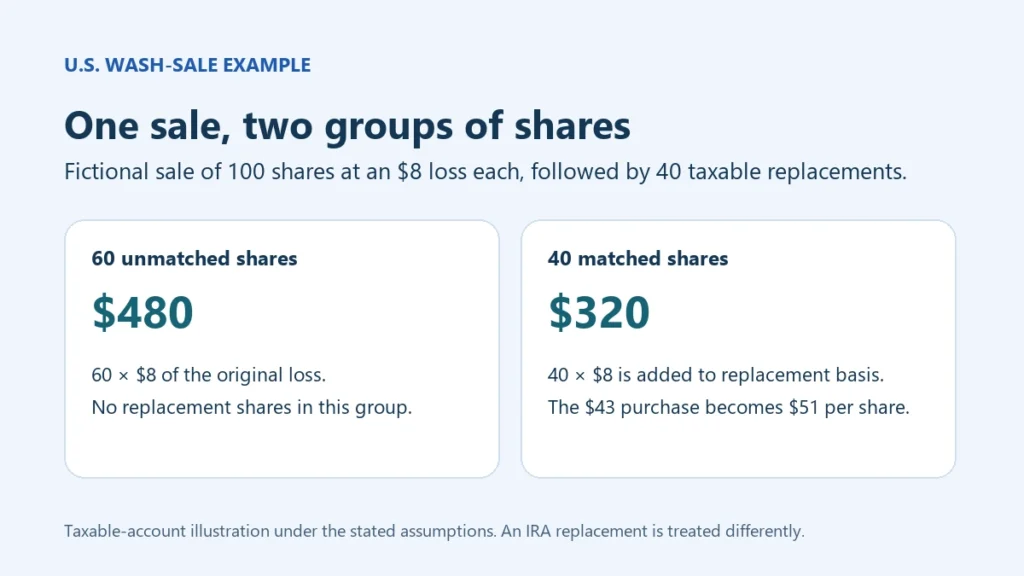
| Loss disallowed on 40 matched shares | 40 × $8 | $320 disallowed |
| Loss remaining on the unmatched shares | 60 × $8 | $480 loss before other tax rules |
| Adjusted basis of the replacement taxable lot | (40 × $43) + $320 | $2,040, or $51 per share |
With multiple purchased or sold lots, match qualifying replacement shares in the order described by the IRS. In the ordinary taxable replacement case, the disallowed loss increases the replacement basis and the old holding period carries over. If the replacement in this example were in the investor’s IRA or Roth IRA, Revenue Ruling 2008-5 describes a different outcome. The disallowed amount would not increase the basis of the IRA or Roth IRA.
Reconcile records before filing
A broker’s Form 1099-B may not identify purchases in a second account. Publication 550 explains the same-account and same-CUSIP conditions under which the broker reports a disallowed loss for covered securities. A blank box 1g therefore does not establish that every loss is deductible. The Form 8949 instructions explain the wash-sale adjustment and code W for the relevant filing year.
- Gather dates, quantities and adjusted basis by lot, including activity at other brokers and any qualifying retirement-account purchases.
- Check dividend reinvestment or recurring purchases that might add fractional shares inside the window.
- Separate a portfolio-maintenance decision from its tax treatment. The portfolio drift guide covers the allocation decision. A qualified U.S. tax professional can help apply the tax rules to unclear facts or multiple accounts.
Reconcile the replacement lot as a separate record
Keep one row for the original sale and another for the 40 replacement shares. On the original sale row, retain the original share count, purchase basis, sale proceeds, and the separately calculated adjustment. On the replacement row, retain the purchase date, original purchase cost and allocated basis adjustment. This makes it possible to explain why a broker statement might show a $43 purchase price while the example’s adjusted tax basis is $51 per replacement share. The extra $8 belongs only to the matched shares in this example.
As a reconciliation check, 60 unmatched shares account for $480 of the original $800 loss, and 40 matched shares account for the other $320. If a second purchase falls inside the window, recalculate the match using the dates and quantities across the relevant accounts before relying on these figures. Keep the broker statement and your own lot record together so a reviewer can trace any difference.
References and method
Use the references to check the factual explanations. Calculations and interpretations are Market Master’s own unless attributed otherwise. The assumptions and limits are stated alongside the relevant example.
Supporting references (3)
IRS, Publication 550 (2025), Wash Sales ↗www.irs.gov
IRS, Instructions for Form 8949 (2025) ↗www.irs.gov
IRS, Revenue Ruling 2008-5 ↗www.irs.gov
Published by Market Master, an owner-operated publication led by Andrejus S. Editorial responsibility and production methods · Report a correction.