

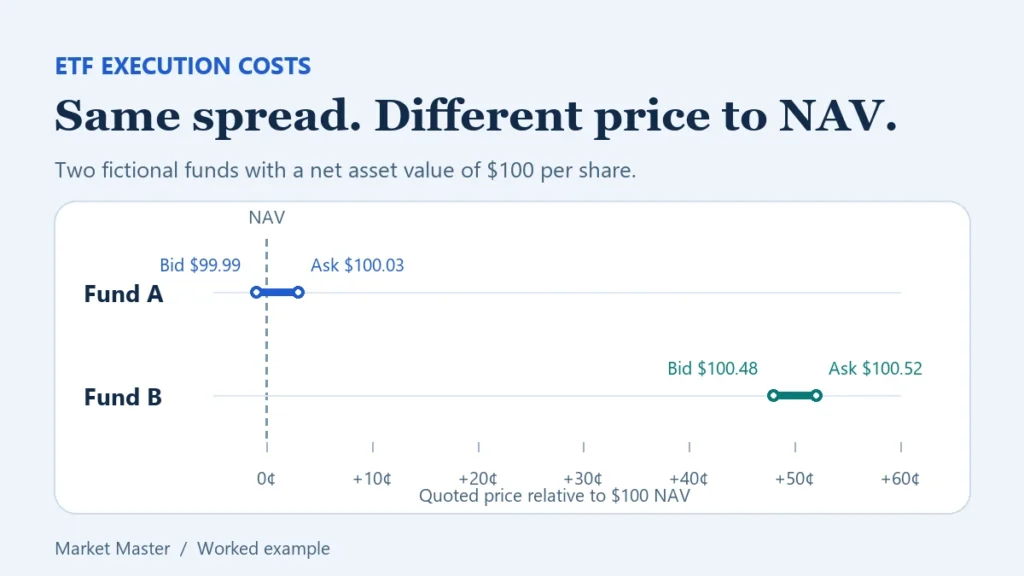
A fund can have a four-cent bid–ask spread and still cost 52 cents more per share than its reported net asset value. The spread measures the distance between two quotes. The premium compares market price with the net value of the portfolio per share. You need both comparisons to understand what an ETF trade may cost. SEC guide to exchange-traded funds
Compare the bid, ask and NAV on the same clock
The bid is the price quoted by a buyer. The ask is the price quoted by a seller. Their midpoint is the average of the two, and the quoted spread is the ask minus the bid. Express the spread in basis points by dividing it by the midpoint and multiplying by 10,000. One basis point equals 0.01 percentage points.
Net asset value, or NAV, is a separate figure. It reflects the value of the fund’s assets after liabilities, divided by the number of shares outstanding. ETFs calculate NAV and publish associated market-price information. For funds relying on the U.S. ETF rule, the daily market-price measure is generally the official close, with a midpoint alternative when it more accurately represents the price at the time NAV is calculated. A broker quote at noon and yesterday’s NAV answer different questions. SEC investor bulletin on fund pricing · U.S. ETF rule, definitions and website disclosure
Work the same-size trade twice
Assume two fictional ETFs each report a $100.00 NAV and these quotes are observed at that same valuation time. Assume a buyer can fill 100 shares at the displayed ask, with no commission, tax or price movement during the order. The midpoints below are analytical references for the example.
| Measure | Fund A | Fund B |
|---|---|---|
| NAV per share | $100.00 | $100.00 |
| Bid and ask | $99.99 / $100.03 | $100.48 / $100.52 |
| Quote midpoint | $100.01 | $100.50 |
| Quoted spread | $0.04 | $0.04 |
| Midpoint above NAV | $0.01 | $0.50 |
| Ask above midpoint | $0.02 | $0.02 |
| Cost for 100 shares | $10,003 | $10,052 |
| Cost above the $10,000 NAV reference | $3 | $52 |
For Fund B, $50 of the $52 gap comes from the midpoint premium and $2 from paying the ask instead of the midpoint. The full spread is $4 across 100 shares. That full spread would be the cost of buying at the ask and immediately selling at the bid if both quotes stayed fixed and could fill the order. Adding $4 to the $50 as the purchase cost would put the sell-side half of the spread into a one-way trade. The actual fill can also differ from the displayed quote, especially when the order is larger than the size available there.
The $52 gap is a comparison to NAV at one point in time. It does not predict a future loss. If Fund B later trades at NAV, the premium has narrowed. If it still trades at a premium when the investor sells, that later premium can affect the proceeds. The underlying portfolio value can move in either case. Evaluate the price reference and the intended trade separately.
Use the issuer’s spread history and your actual fill
First, check the issuer's daily NAV and market-price history for the same fund, share listing and currency. Note how the issuer defines market price. If the fund holds assets whose home market is closed while the ETF trades, check what the NAV timestamp represents before treating a large gap as an execution problem. The quote may reflect information that arrived after some portfolio prices were observed.
Next, compare the spread at the intended trading time with the issuer's 30-day median. A median summarizes past quotes, so it can miss a wide spread on the day you trade. Record the actual fill and the quote near execution. Comparing the fill with the contemporaneous midpoint helps estimate the execution component. Comparing the same midpoint with an appropriately timed NAV helps explain the valuation gap. Keep brokerage charges separately visible in the record. U.S. ETF rule, spread disclosure
Finally, if you are replacing one fund with another, estimate the execution cost of both legs. A sale from the first fund and a purchase of the second each have their own spread and available size. If the estimate already uses executable bid and ask prices, the spread is embedded and should not be added a second time. Use the ETF switching-cost worksheet to compare the combined execution allowance and other one-time charges with the recurring fee saving. Keep any uncertain premium movement as a separate scenario.
References and method
Use the references to check the factual explanations. Calculations and interpretations are Market Master’s own unless attributed otherwise. The assumptions and limits are stated alongside the relevant example.
Supporting references (3)
SEC guide to exchange-traded funds ↗www.investor.gov
SEC investor bulletin on fund pricing ↗www.investor.gov
U.S. ETF rule ↗www.ecfr.gov
Published by Market Master, an owner-operated publication led by Andrejus S. Editorial responsibility and production methods · Report a correction.