

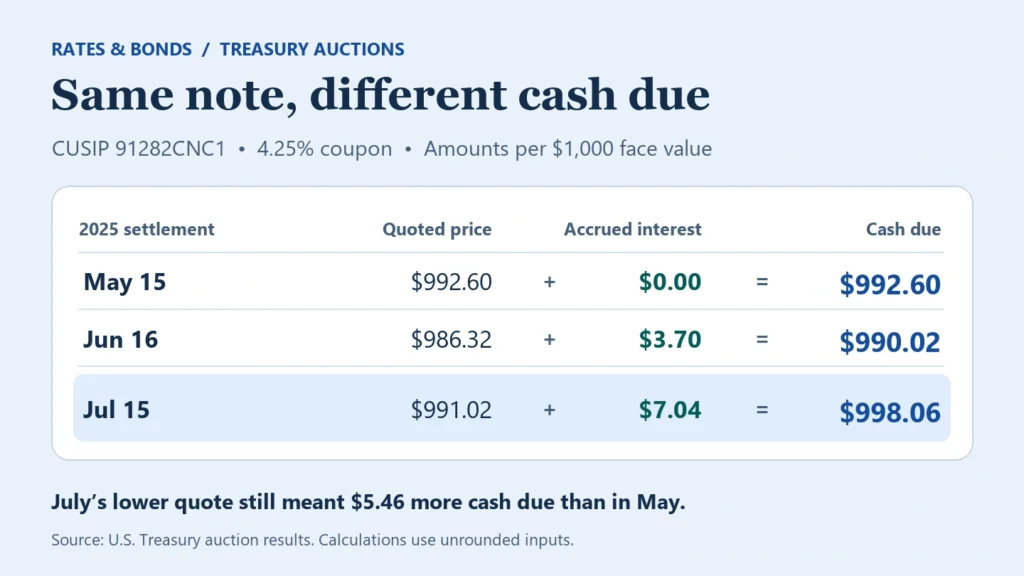
In July 2025, Treasury sold more of a 10-year note it first issued in May. The coupon stayed at 4.25% and the maturity stayed May 15, 2035. The July auction price was 99.101876 per $100 face value, so $1,000 face value cost $991.01876 before accrued interest. The auction also charged $7.04484 in accrued interest per $1,000. Adding the two gives an estimated cash payment of $998.06 after rounding to cents. July 9 auction result
Match the security across the auctions
A reopening adds more of an outstanding security. Match the CUSIP, coupon and maturity before comparing the quoted prices. In this case, all three auctions refer to CUSIP 91282CNC1. Buyers received the same regular coupon per $1,000 face value. The amount of cash paid at settlement and the time until the first coupon differed. Treasury reopening schedule
| Auction date | Settlement date | High yield | Quote per $100 | Accrued interest per $1,000 | Estimated cash per $1,000 |
|---|---|---|---|---|---|
| May 6, 2025 | May 15, 2025 | 4.342% | 99.260100 | $0.00000 | $992.60 |
| June 11, 2025 | June 16, 2025 | 4.421% | 98.632474 | $3.69565 | $990.02 |
| July 9, 2025 | July 15, 2025 | 4.362% | 99.101876 | $7.04484 | $998.06 |
Estimated cash equals the quote multiplied by 10, plus the published accrued interest per $1,000. The table rounds the final estimate to cents and excludes any charges a broker might apply. The high yield is the auction’s accepted yield for pricing the note. It differs from the coupon, which is applied to face value. The July quote was below May’s, yet the July buyer paid about $5.46 more at settlement because of accrued interest. May auction result · June auction result · Treasury pricing and interest rates
You can reproduce the accrued interest for this regular coupon period from the schedule. May 15 to November 15 covers 184 days. June 16 settlement falls 32 days into that period, and July 15 falls 61 days into it. Multiply the $21.25 half-year coupon by 32 ÷ 184 or 61 ÷ 184 to get $3.69565 or $7.04484, respectively, to five decimal places. The dates come from the security’s offering and award records. Irregular first coupons, inflation-adjusted notes and floating-rate notes require their own conventions. Treasury auction regulations, Appendix B
Read the first coupon together with the settlement debit
The note pays a regular $21.25 every six months per $1,000 face value, calculated as $1,000 × 4.25% ÷ 2. The offering lists May 15 and November 15 as the scheduled interest dates. The July buyer pays for the part of that coupon period that elapsed before settlement, then receives the full coupon when due. Subtracting the upfront accrued interest from the first coupon leaves about $14.21 attributable to this first holding interval under the example’s cash arithmetic. The full coupon still appears as a payment. June reopening announcement and interest dates · Treasury note terms
The roughly $14.21 measures part of the first coupon in dollars. Yield to maturity takes account of the acquisition price, the remaining payment dates and the amount repaid at maturity. A sale before maturity produces a different result that depends on the sale price, interest received and any transaction costs. The quotes here are historical auction results. For a live secondary-market purchase, reconcile the actual quoted price, settlement date, accrued interest and fees on the order preview.
Check how a separate fee changes the cash you need
Use the July settlement as a baseline and assume a separate $3 transaction fee for illustration. The same $1,000 face amount would require $1,001.06 in cash, even though the quoted price of the note is below par. The fee changes the initial outlay. The note still pays a regular $21.25 coupon and returns $1,000 at maturity. Keep the fee on its own line so your cash ledger can explain the difference between the quoted price and the debit.
On a real order preview, check whether the broker has already included its markup in the quoted price before adding a charge yourself. Also check whether the displayed total already includes accrued interest. Adding either amount twice overstates the cash you need and understates the return you calculate from that outlay.
Keep a four-line cash ledger
- Record the CUSIP, settlement date and maturity date from the same trade confirmation.
- Convert the price per $100 into the amount for your face value, then add accrued interest and any fees to get the settlement debit.
- Record the full coupon and its scheduled payment date. Keep the initial accrued-interest debit on its own line so you can reconcile cash without counting it twice.
- Put the maturity proceeds on their own date. If the cash is meant to cover several expenses, map each expense against the dates funds become available.
References and method
Use the references to check the factual explanations. Calculations and interpretations are Market Master’s own unless attributed otherwise. The assumptions and limits are stated alongside the relevant example.
Supporting references (8)
July 9 auction result ↗www.treasurydirect.gov
Treasury reopening schedule ↗treasurydirect.gov
May auction result ↗www.treasurydirect.gov
June auction result ↗www.treasurydirect.gov
Treasury pricing and interest rates ↗www.treasurydirect.gov
Treasury auction regulations, Appendix B ↗www.treasurydirect.gov
June reopening announcement and interest dates ↗treasurydirect.gov
Treasury note terms ↗www.treasurydirect.gov
Published by Market Master, an owner-operated publication led by Andrejus S. Editorial responsibility and production methods · Report a correction.