

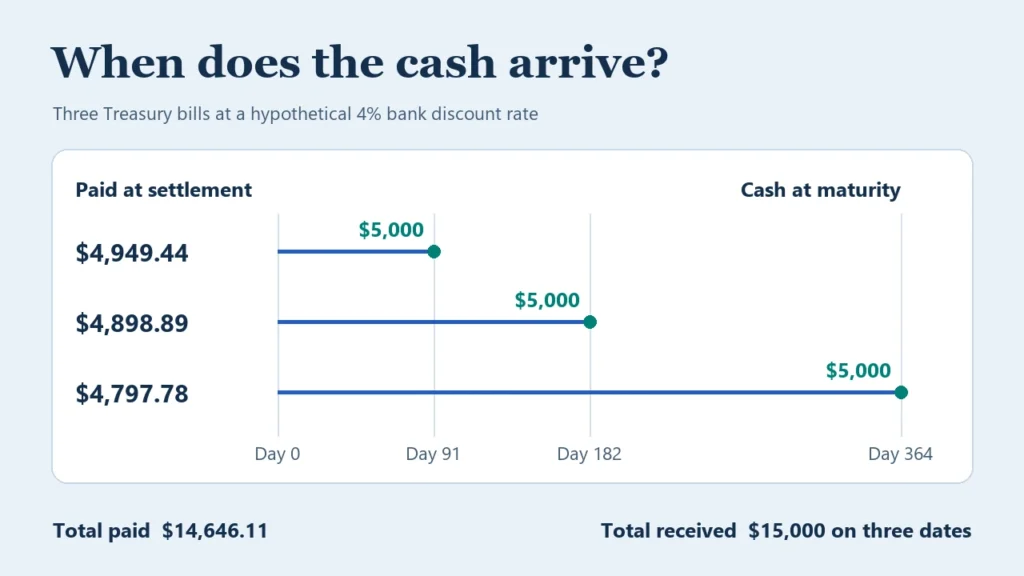
A Treasury bill ladder staggers maturities so some of the money becomes available sooner than the rest. Start with the date each payment must clear and the amount you need in your bank account. Then decide which cash can stay invested. A ladder that looks orderly on a chart can still leave you short if its first maturity falls after your first bill is due.
Keep purchase price, face value and yield separate
The face value is the cash the U.S. Treasury pays when the bill matures. A bill bought below face value earns the difference between that amount and its purchase price. There are no interim coupon payments. TreasuryDirect publishes the formula that translates an auction discount rate into a purchase price. Treasury bill terms · Treasury pricing formula
For a $5,000 bill with 91 days to maturity and an assumed 4.00% annual bank discount rate, the purchase price is $5,000 × (1 − 0.04 × 91 ÷ 360), rounded to $4,949.44. The $50.56 gain works out to about 1.02% of the purchase price over 91 days. The quoted 4.00% uses face value and a 360-day convention. Compare rates only after checking what convention each quote uses.
Map the maturity dates to the bills you actually owe
Assume all three hypothetical bills settle on day 0, with equal face values and a 4.00% bank discount rate for each. That common rate makes the cash-flow differences easy to reproduce. Real auctions clear at separate prices, and securities settle and mature on their stated dates. The table counts days from settlement and excludes tax and trading costs.
| Days to maturity | Paid at settlement | Cash at maturity | Difference |
|---|---|---|---|
| 91 | $4,949.44 | $5,000.00 | $50.56 |
| 182 | $4,898.89 | $5,000.00 | $101.11 |
| 364 | $4,797.78 | $5,000.00 | $202.22 |
| Total | $14,646.11 | $15,000.00 | $353.89 |
The total maturity cash arrives in three payments. If $5,000 is due on day 85, the first maturity arrives six days too late. If $7,000 is due on day 160, only the first $5,000 has matured. Starting with $15,000 would leave $353.89 uninvested in this example, still insufficient to cover the remaining $2,000. Keep enough accessible cash or use maturities that precede the actual payments. Allow time for funds to reach the account you pay from. Where a date is inflexible, verify settlement, maturity and transfer timing before relying on it.
Reinvest only the cash you can spare
Suppose the day-91 maturity can be reinvested for another 91 days. The replacement has the same $5,000 face value and begins on the first bill’s maturity date. Because the reinvestment is below par in these examples, the difference stays in cash. The original day-182 bill remains scheduled to mature alongside the new bill, so this same-term reinvestment now puts $10,000 of face value on one maturity date.
| New 91-day bank discount rate | Replacement purchase price | Cash left from the $5,000 redemption |
|---|---|---|
| 2.00% | $4,974.72 | $25.28 |
| 4.00% | $4,949.44 | $50.56 |
| 6.00% | $4,924.17 | $75.83 |
At the lower rate it costs $25.28 more than the 4.00% case to secure the same $5,000 at the second maturity. The two bills you already own retain their original maturity amounts. The uncertain part is the rate available on the money you want to roll. That is reinvestment risk. Auto-roll can simplify the purchase, but rolling into the same term may bunch payments together or extend money past a deadline. TreasuryDirect describes same-term reinvestment for bills. Check your own account’s timing and instructions before scheduling a roll. TreasuryDirect reinvestment and redemption
When the maturity ledger stops being enough
The table assumes every bill is held until maturity. An earlier sale depends on the price available that day, so the maturity value does not tell you how much you could raise today. A bond ETF adds another distinction. Its share price and distributions vary, and holding a share until one of the portfolio’s bills matures does not entitle you to that bill’s face value. For a worked example of how rate moves affect a bond fund’s traded price, read the long-Treasury ETF case.
Use a simple ledger for your next comparison. Write down each payment’s amount and due date, which maturity funds it, when the proceeds must reach your bank and any cash buffer. Keep a separate column for maturities you can roll. Reprice just those rows at lower and higher rates to see which part of your future interest depends on the next auction.
References and method
Use the references to check the factual explanations. Calculations and interpretations are Market Master’s own unless attributed otherwise. The assumptions and limits are stated alongside the relevant example.
Supporting references (3)
Treasury bill terms ↗www.treasurydirect.gov
Treasury pricing formula ↗www.treasurydirect.gov
TreasuryDirect reinvestment and redemption ↗www.treasurydirect.gov
Published by Market Master, an owner-operated publication led by Andrejus S. Editorial responsibility and production methods · Report a correction.