

Two investments can own the same kind of U.S. government debt and serve different purposes. An individual Treasury note promises cash flows on specific dates. A conventional Treasury ETF can keep buying and selling notes to maintain exposure to a maturity range. A rate increase can push down the market value of both. The practical difference is what you own when the date on your calendar arrives.
Write down the cash flows before looking at the yield
Suppose you buy a hypothetical five-year Treasury note with $1,000 face value and a 4% annual coupon at par on a coupon date. The coupon pays $20 every six months. On the final payment date, five years later, the Treasury owes the last $20 coupon and $1,000 principal. Those amounts assume the Treasury makes the scheduled payments. Their timing is specified by the note. The interest you earn by reinvesting those coupons depends on the rates available when you receive them.
A conventional rolling Treasury ETF owns a changing basket. For example, the iShares 7–10 Year Treasury Bond ETF tracks an index of Treasuries in a specified remaining-maturity range. Its shareholders hold fund shares. An underlying bond's maturity payment belongs to the fund, and a shareholder who needs cash on a particular date generally sells shares at the available market price. Find the fund's maturity range, distribution policy and duration in its own documents. Check the prospectus separately for a fund that has a stated termination year, since that structure differs from the rolling fund described here. TreasuryDirect note mechanics · iShares fund fact sheet
Reprice the same note at three yields
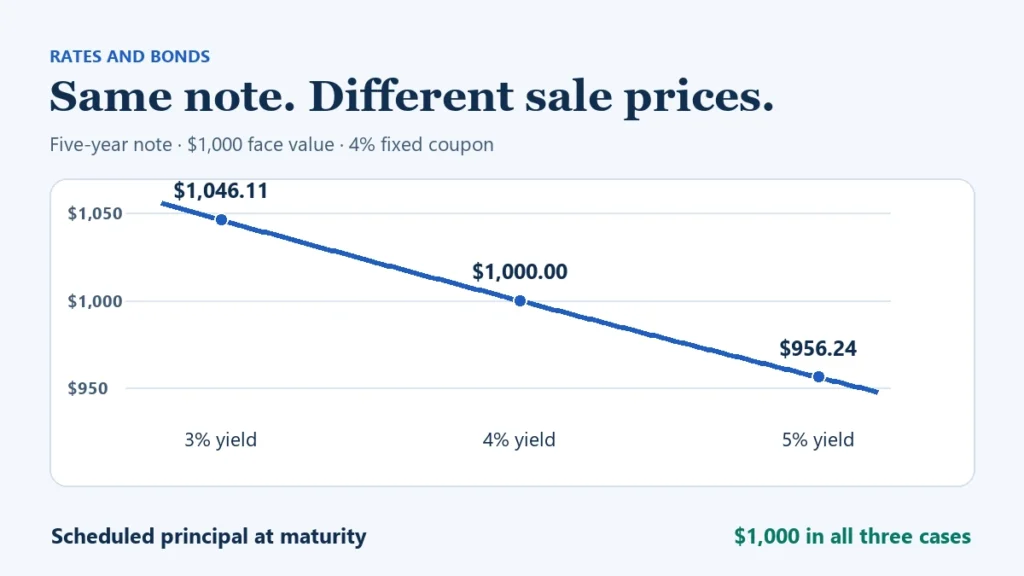
Now assume the yield changes immediately, before any time elapses or any payment is made. Keep all ten half-year payment dates. Discount the $20 coupons and $1,000 principal at the new yield divided by two, using half-year periods. At 5%, the first $20 is worth $20 ÷ 1.025 today. The final $1,020 is worth $1,020 ÷ 1.025¹⁰. Sum every discounted payment to obtain $956.24.
| Hypothetical yield | Note price today | Change from the $1,000 starting price | Principal scheduled at maturity |
|---|---|---|---|
| 3.00% | $1,046.11 | +4.61% | $1,000 |
| 4.00% | $1,000.00 | 0.00% | $1,000 |
| 5.00% | $956.24 | −4.38% | $1,000 |
The $43.76 decline matters if you must sell immediately. If you hold the note to maturity and the Treasury pays as scheduled, the 5% quote changes today's sale value while the note's payment dates and dollar amounts stay fixed. The example assumes no accrued interest, trading costs, taxes, inflation or credit changes. It prices the note at one point in time and does not calculate a holding-period return. Investor.gov guide to bonds
Use duration to ask the same question of a fund
For a hypothetical rolling fund with a duration of 4.5 years, a one-percentage-point rise across the relevant yields implies an approximate 4.5% decline in portfolio value before distributions and other effects. Multiply duration by the yield change as a decimal and reverse the sign. So 4.5 × 0.01 is 0.045, or 4.5%. On $1,000 of starting value, that is about $45. The 4.5-year input is fictional and does not describe the iShares fund above.
The result is close to this note's initial one-point response because the note starts with a modified duration of roughly 4.49 years. But they reach future dates differently. As time passes, the note has fewer promised payments left. A rolling fund can replenish the maturity range and keep substantial interest-rate sensitivity. A fund's duration summarizes its exposures at the time reported. It is worth checking again before using an old estimate. Investor.gov guide to bond funds · Fund duration definition
Where this math fails
Duration is a small-move approximation. The table shows the note rising 4.61% for a one-point fall in yield and falling 4.38% for a one-point rise. A straight-line estimate misses that asymmetry. The front and back of the Treasury curve can also move in different directions. A fund's NAV and traded share price can differ, and expenses, distributions and reinvestment matter when you measure total return. For a non-U.S. reader, the exchange rate can change the value of the dollar cash flows in their spending currency.
Start with one question. Do you need a known dollar amount on a known date, or continuing exposure to a range of Treasury maturities? For the first, list the cash needed at each date and check what is scheduled to arrive beforehand. For the second, compare the fund's duration with the size of a plausible yield move and check the fund's maturity mandate. Use the Treasury bill ladder example to map the dates and amounts for the first exercise.
References and method
Use the references to check the factual explanations. Calculations and interpretations are Market Master’s own unless attributed otherwise. The assumptions and limits are stated alongside the relevant example.
Supporting references (4)
TreasuryDirect note mechanics ↗www.treasurydirect.gov
iShares fund fact sheet ↗www.ishares.com
Investor.gov guide to bonds ↗www.investor.gov
Investor.gov guide to bond funds ↗www.investor.gov
Published by Market Master, an owner-operated publication led by Andrejus S. Editorial responsibility and production methods · Report a correction.